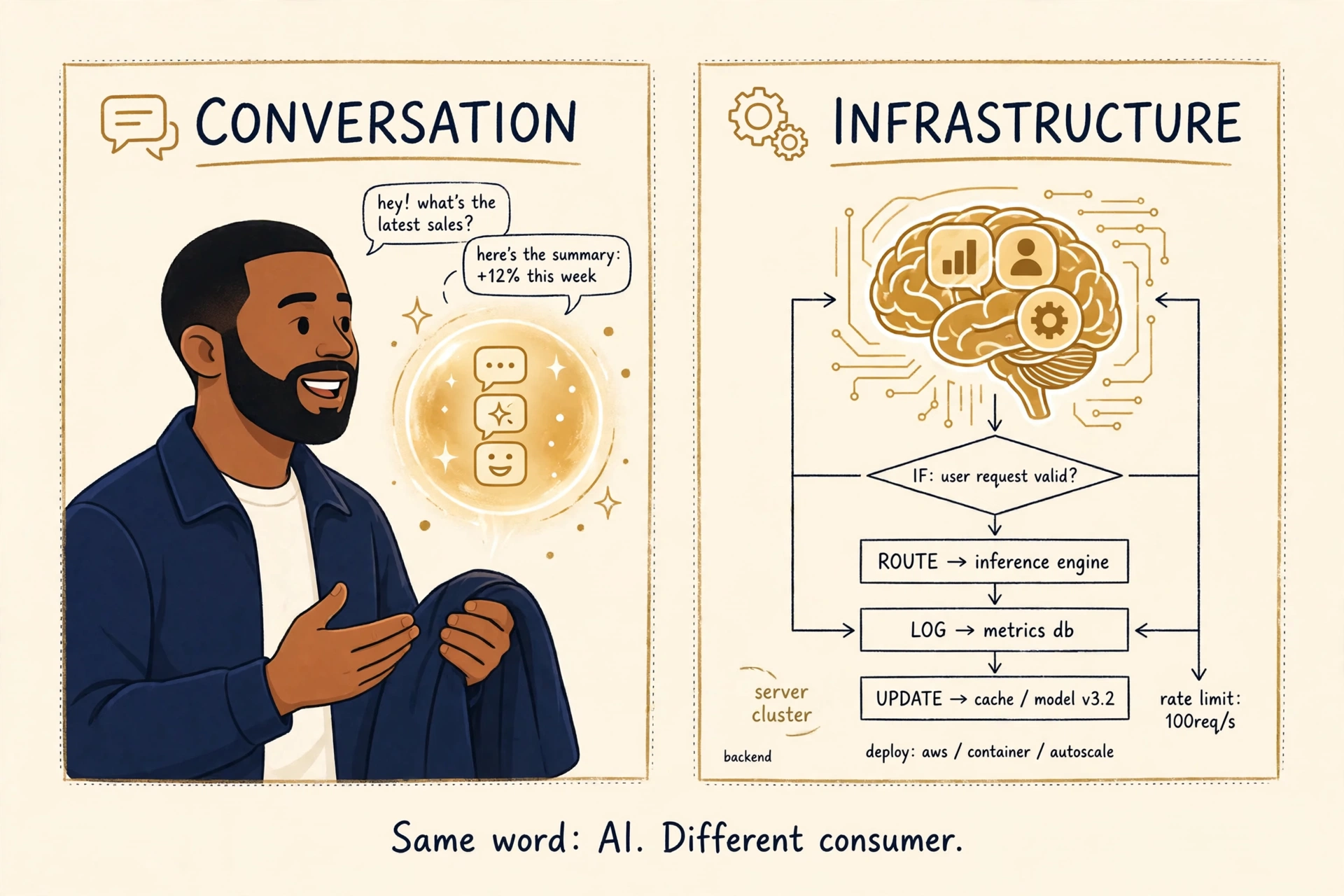
Here's the short version: Most AI we've been using is built to talk to people. Jev is built so code can consume intelligence the way software already consumes a database query or a regex. That shift (if it holds) is less about a cooler chatbot and more about whether boring, valuable work can finally get reliable automation plugs.
I'm still making sense of it. This is my field notes.
The question that stuck with me
Diogo Almeida (TypeSafe CEO, InstructGPT co-author) opens a lot of his explanation with a question that sounds almost rude:
How can AI solve absurdly hard math problems and still fail to automate basic, economically valuable work?
That question is doing a lot of work. It names the weird feeling a lot of us already have at our desks. The demos look brilliant. The everyday handoff still needs a human to babysit tone, retries, refusals, and "please put that in a spreadsheet."
I've been writing about agents that pick up real work, and about principles that transfer across tools. Jev sits in that same curiosity lane. Not "which model writes the prettiest paragraph," but "what would make intelligence safe enough to bury inside the workflow."
What it is (in plain language)
Jev is TypeSafe's first big public model in a class Diogo calls System One models (also: large programmable models, machine-native models). The branding will probably keep shifting. The design target is clearer than the label:
Code is the consumer.
Not autocomplete-of-the-internet. Not "helpful assistant replies to my chat." The point is intelligence that software can call the way it calls other software.
That sounds small until you sit with it. Chat models are optimized to please a human in a thread. A dependency running in the background has a different job. It needs to be predictable enough that a product team will stake real decisions on it. Diogo's blunt version: safety refusals that make sense in ChatGPT can become a type error inside an API. If a buried call randomly refuses because a weird string showed up upstream, the whole product looks broken to someone who never even knew AI was involved.
Why it's called Jev
The name points at Jevons Paradox and a product north star: intelligence per dollar.
In Diogo's framing, labs argue about reliability, cost, calibration, and speed. TypeSafe is openly optimizing the Pareto frontier of intelligence per dollar (with speed as a related but different game: intelligence per second). The practical implication for builders: they want models you can afford to call a lot, because the recommended style of use is many small decisions, not one giant prompt.
The real talk: three different north stars
This is the part that clicked for me once I stopped treating the acronyms as homework.
Diogo's "bitterest lesson" idea (building on Sutton, then sharpening it): you get what you optimize for. Architecture and compute matter. The task you train for matters more than people admit. He describes TypeSafe less as a model lab and more as a data lab chasing the right task shape.
Here's the contrast I'm using to keep it straight:
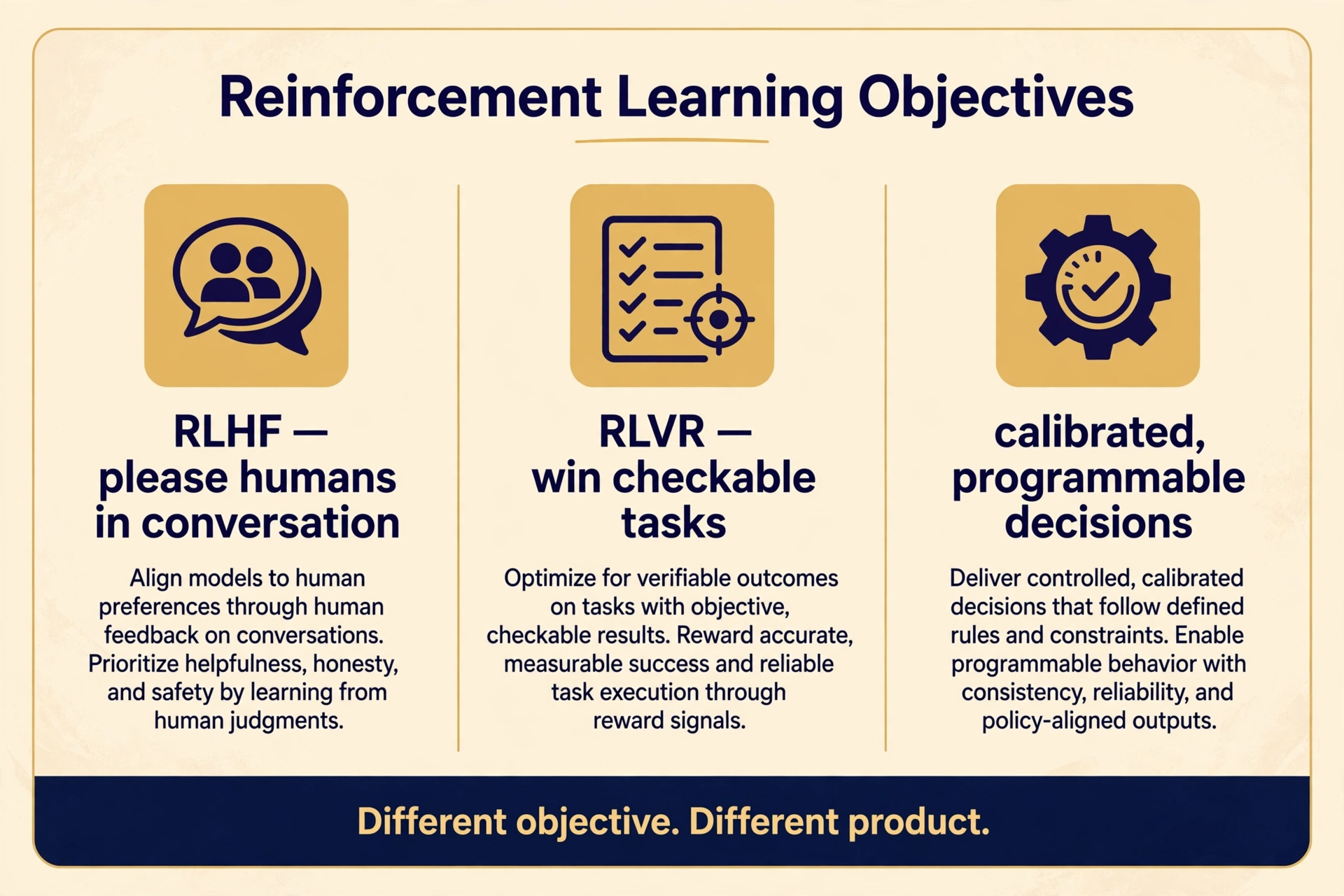
| Training north star | Roughly optimizes for | Feels like in real life |
|---|---|---|
| RLHF (human feedback / instruction following) | Please humans in conversation | Great chat partner. Can get sycophantic, mode-collapsed, or oddly cautious when you need a clean decision. |
| RLVR (verifiable rewards / rubric-style checks) | Win programmatically checkable tasks | Amazing at jagged "prove it" domains (think hard math). Still not the same as "reliable coworker inside messy software." |
| RLCD (Reinforcement Learning for Calibrated Decisions; TypeSafe's unpublished technique as described on the pod) | Calibrated, programmable decisions for System One tasks | Built so software can ask small questions and get epistemically honest probabilities, not vibes. |
I'm not claiming I've audited RLCD under the hood. Diogo says they haven't published the paper yet. What I'm taking away as a practitioner is simpler:
If you train models primarily to chat with humans, don't be shocked when they behave like chatty intern energy inside a production workflow.
That's the connectivity to everyday work. The failure mode isn't "AI isn't smart." The failure mode is "we optimized for the wrong job."
How you're supposed to use it (this is the actual craft)
Diogo's builder advice is almost aggressively unsexy, which is why I trust it more than launch memes.
1. Decompose into the smallest semantic unit
Don't throw a novel into a system prompt and hope. Break the work into tiny, measurable decisions.
His refusal example stuck with me. Instead of one fuzzy question ("Should I refuse here?"), ask many independent questions about the situations that matter to your product. When something fails, you add the missing question. That's software engineering: fix the bug in the control flow, not by yelling at a paragraph generator.
This docks cleanly into something I've already been saying about agents: give one agent one useful job, define the finish line, keep consequential actions reviewable. Jev is the "decision layer" version of that instinct.
2. Prefer structure over mega-prompts
Inputs like state, instructions, and criteria can be structured objects (JSON-shaped), not one giant string soup. Diogo's dig at system messages as "disgusting global variables" is spicy, and also useful. If you've ever watched an agent forget a rule because the prompt got long, you already know the pain.
3. Use primitives that map to code
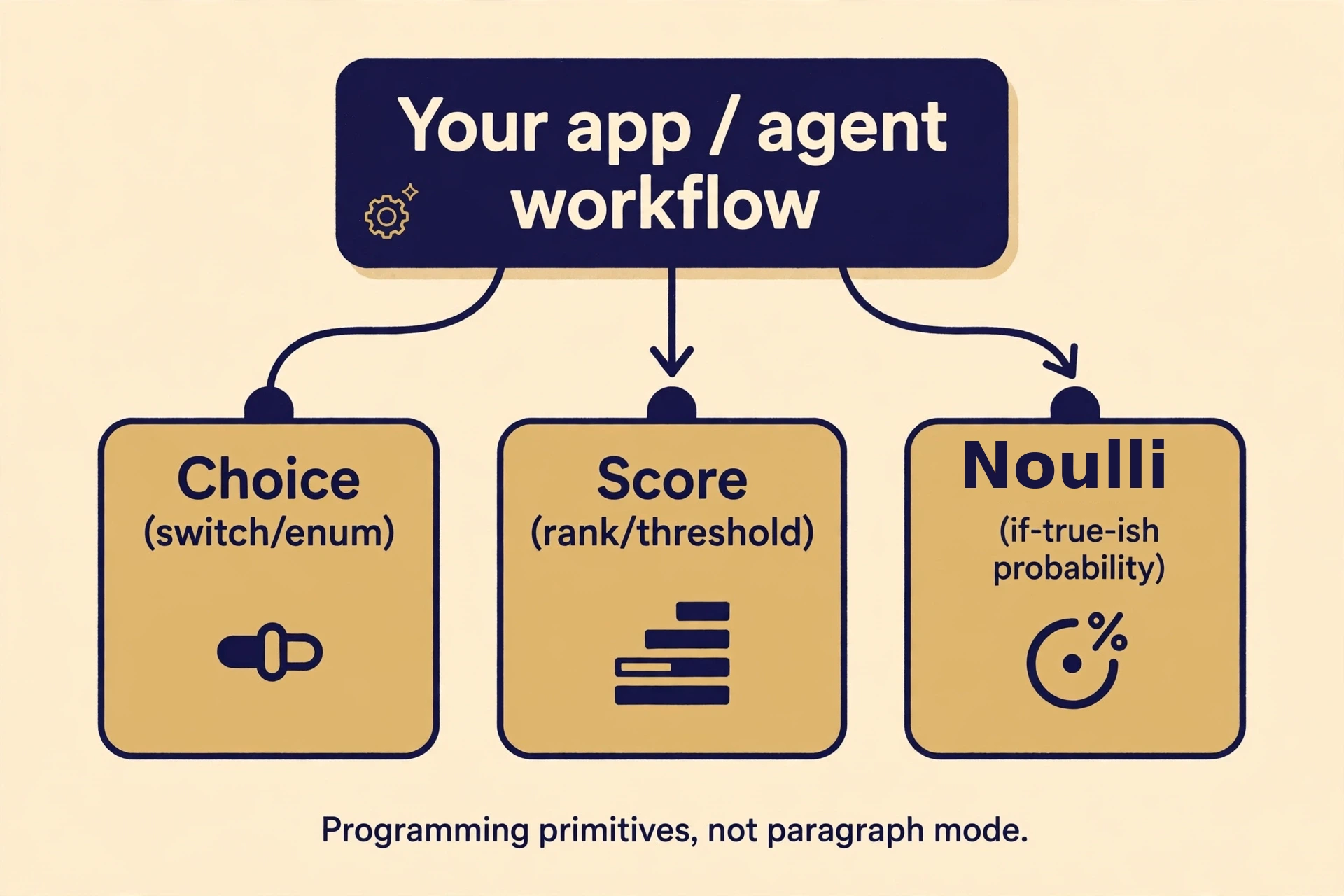
On the pod he walks three primitives (names may evolve in the docs):
- Choice → switch / enum style branching
- Score → ranking, judging, thresholding
- Noulli (Bernoulli-inspired, bool-ish continuous) → if-style gates with probability
The point isn't to memorize branding. The point is: intelligence shows up as control flow, not as an essay.
4. Optimize for robustness, not cosplay determinism
Same input → same output (determinism) is tidy for unit tests. Diogo argues what people often need more is robustness: similar inputs → similar outputs, even when you sprinkle noise that shouldn't change meaning. He'll ship determinism if developers prove they need it. Until then, intelligence per dollar wins the tradeoff.
Why it matters for everyday work (even if you never call the API)
If you only build PowerPoints and meeting notes, why care?
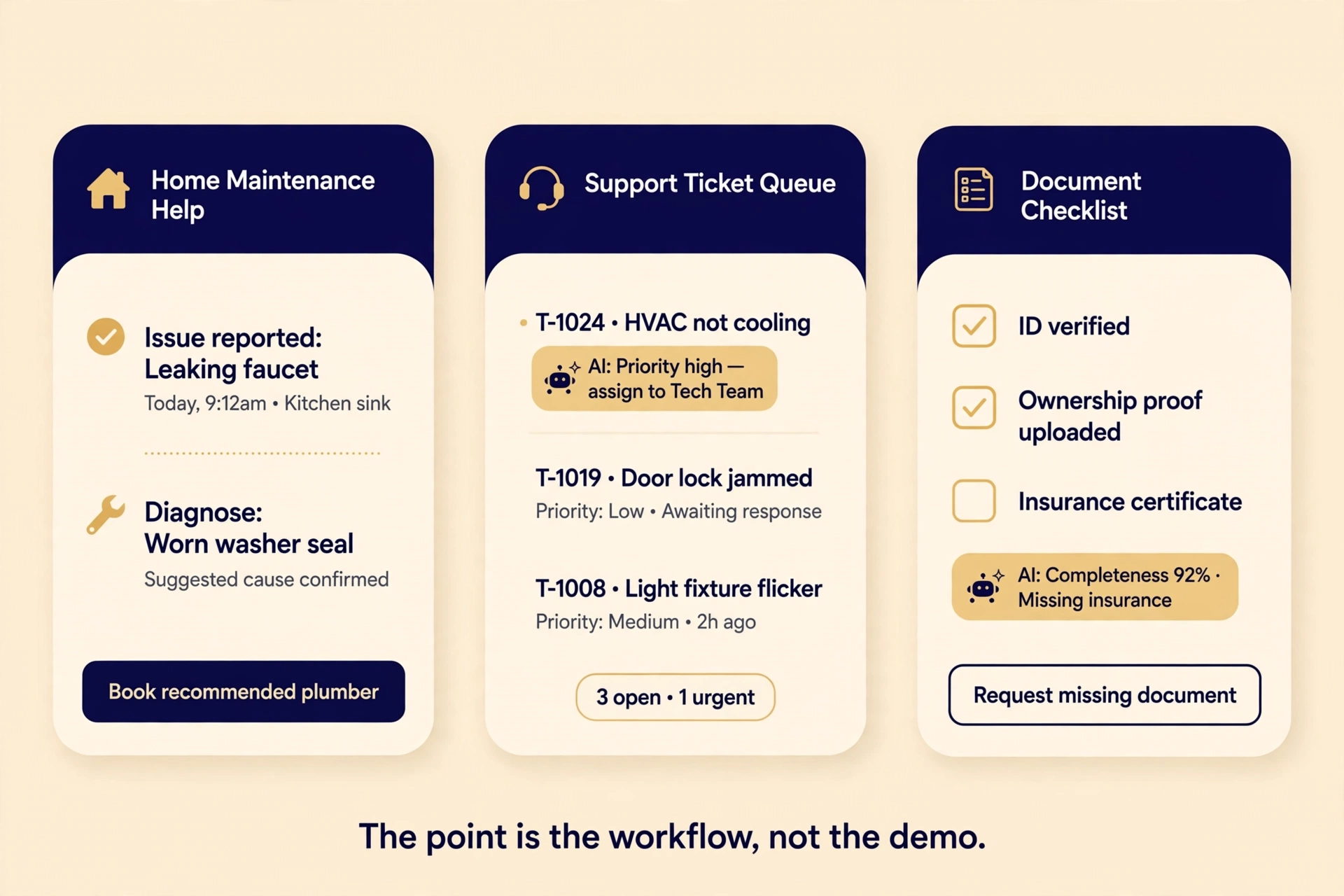
Because the next wave of "AI at work" is not another sidebar chat. It's whether the systems we already use (ticketing, CRM, document review, home maintenance triage, fitness coaching, community moderation) can make small, trusted decisions without turning every step into a conversation.
Diogo calls the dream state something like AI disappearing into the background. As unremarkable as infrastructure. He even floats a future where intelligence-per-dollar gets cheap enough that some regex-shaped problems just become model calls. Weird? A little. Also a useful compass: the win is when nobody has to perform "using AI."
He also talks about an "inverse SaaS apocalypse": not software dying, but existing software getting supercharged because the companies that own workflows finally get reliable decision plugs. That matches what I see in enterprise architecture land. The bottleneck is rarely "can a model write a paragraph." The bottleneck is trust, evaluation, permissions, and handoffs.
So the everyday translation I'm carrying:
- Stop evaluating every model as a chatbot. Ask: can this decision run without me in the room?
- Prefer workflows you can measure. Small questions beat vibes.
- Keep humans on consequential actions. Calibration and confidence estimates are tools for escalation, not a reason to go autopilot on money, deletion, or external sends.
- Watch for AI that wants to be the main character. The interesting products may be the ones where AI is boring on purpose.
What I'm still holding loosely
A few hedges, because launch week is loud and I wasn't in the room for the metrics:
- Traction numbers Diogo mentioned on the pod (very high token throughput, big Discord/community energy, huge launch-video view counts) are his report of launch-week reality. Treat them as claims to verify against TypeSafe's own updates, not as my independent measurement.
- RLCD is a named north star with limited public paper trail so far. Useful as a frame. Not something I'm pretending to reverse-engineer.
- Not everything should be "Jev'd." Diogo himself laughs at the idea that people will try to shove every problem into System One. Hard, fragile, high-stakes domains still need different tools, humans, or slower System Two style reasoning stacks.
- I'm a learner here. My lane is making technology usable for everyday work and connecting ideas across tools. The ML internals are their job. The product implications are what I'm stress-testing.
Try this if you want a concrete next step
Pick one recurring decision in your week that is:
- frequent
- boring
- checkable after the fact
- not catastrophic if wrong once
Examples: triage a support email into three buckets, flag whether a home issue is "call a pro now" vs "schedule maintenance," score whether a draft is ready for a stakeholder.
Write the decision as three to seven tiny yes/no or choice questions instead of one mega-prompt. Decide your thresholds. Decide where a human still reviews.
You can do that exercise with whatever model you already use. The Jev conversation just made the shape obvious.
Closing
Jev, as I'm making sense of it, is less "new chatbot drops" and more "what if intelligence was trained to live inside software the way databases and regexes do." System One. Code as consumer. Intelligence per dollar. Small semantic units. AI that disappears when it's working.
That's the thesis I'm carrying into the next demos I watch and the next agent workflow I design.
Stay curious. If you're trying this decomposition idea at work (or you think I'm missing the plot), say so on Threads. I want the real conversation, not the launch-week cosplay.
Sources for readers
- Latent Space episode page: https://latent.space/p/jev
- Video: https://youtu.be/cFx9Z3ZXca0
- TypeSafe: https://typesafe.ai/
About this draft: Personal learning notes from the published podcast conversation and companion writeup. Not affiliated with TypeSafe. Product details change fast; check primary sources before you build a dependency.